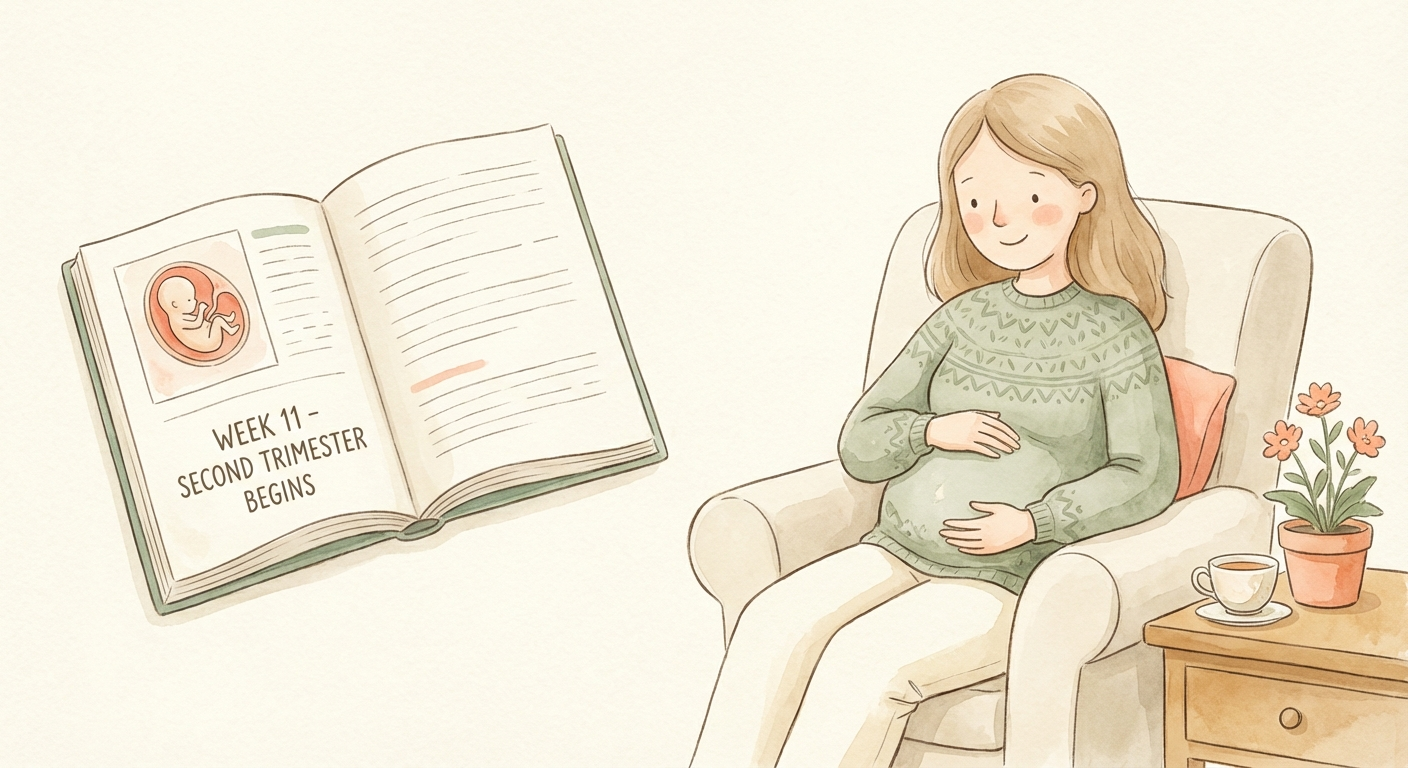
Week 11
Your baby is the size of a
Lime
4.1 cm
Length
7 g
Weight
11 Weeks Pregnant: Baby Doubles in Size This Week
At 11 weeks pregnant, your baby is about the size of a fig (approximately 41-60 mm or 1.6-2.4 inches). Your baby will nearly double in size this week—growing faster than at any other point in pregnancy. The risk of miscarriage decreases significantly after this week.1
What’s Happening at 11 Weeks Pregnant?
Week 11 is a week of rapid growth. Your baby is developing quickly, with significant size increases happening daily. The head is still large relative to the body (making up nearly half of total body length), but the body is lengthening and proportions are gradually balancing.2
This week also marks a turning point in pregnancy safety. Once you reach the end of week 11, the risk of miscarriage drops significantly—from about 15-20% in early pregnancy to just 1-3% after week 12. This is why many people choose to announce their pregnancy publicly around this time or shortly after.[ ^3]
For you, symptoms may be starting to ease as you approach the second trimester. Many people notice morning sickness and fatigue beginning to improve around weeks 11-13.3
How Big is My Baby at 11 Weeks?
Your baby at 11 weeks is about the size of a fig or Brussels sprout, measuring approximately 41-60 millimeters (1.6-2.4 inches) from crown to rump and weighing about 7-8 grams (0.25-0.28 ounces).4
Your baby may nearly double in size this week—experiencing the fastest growth rate of the entire pregnancy. This rapid development requires significant energy and nutrients, which is why adequate nutrition and prenatal vitamins are so important.
Baby Development at Week 11
Incredible growth and refinement characterize week 11:
Rapid growth: Your baby is growing faster than at any other time during pregnancy. Length may nearly double by the end of this week, and body proportions are shifting as the torso lengthens.
Distinct human features: Your baby looks unmistakably human now, with recognizable facial features and body proportions.
Head development: The head is still disproportionately large, but the neck is developing and allowing your baby to lift and turn the head. Ears are moving to their final position on the sides of the head.
Facial features: Your baby’s face is well-defined:
- Eyes are positioned properly
- Eyelids are formed (still fused shut)
- Nose has distinct nostrils
- Upper and lower jaws have tooth buds
- Tongue has functioning taste buds
- Tiny earlobes are visible5
Fingers and toes: Fully separated fingers and toes now have nails beginning to form at the tips. Hand and foot bones are hardening.
Organ development:
- Heart: Beating at 120-160 beats per minute
- Kidneys: Producing urine continuously
- Intestines: Contracting and practicing digestive movements (peristalsis)
- Liver: Producing blood cells
- Pancreas: Producing insulin
- Brain: Developing rapidly with billions of nerve cells forming connections
Skeletal system: Bones throughout the body are hardening and becoming stronger. The skeleton provides structure for muscle development.
Reproductive system: For boys, testes are producing testosterone. For girls, ovaries contain primitive egg cells. External genitalia are developing but aren’t yet clearly distinguishable on most ultrasounds.
Movement: Your baby is incredibly active—kicking, stretching, hiccuping, and even yawning. These movements strengthen muscles and joints, though you still can’t feel them.
Skin: Your baby’s skin is thin and translucent, with visible blood vessels. Over the coming weeks, skin will thicken and become less transparent.
Diaphragm: The diaphragm is forming, and your baby may experience hiccups as this muscle develops.
Common Symptoms at 11 Weeks Pregnant
Week 11 often brings the first signs that symptoms are improving for many people:6
Decreasing morning sickness: While some people still experience nausea, many notice it beginning to ease. Peak symptoms typically occur around weeks 9-10, with improvement starting around weeks 11-13.
Improving energy: Fatigue may start to lift slightly as your body adjusts to pregnancy hormones, though you might still need more rest than usual.
Frequent urination: Your uterus is expanding out of the pelvis, which may provide slight relief from bladder pressure—though frequent urination often continues throughout pregnancy.
Breast changes: Breasts continue to grow and may feel less tender as your body adjusts to hormonal changes.
Visible baby bump: While not everyone shows at this point, you may notice your waistline thickening or a small bump forming, especially if this isn’t your first pregnancy.
Food aversions lessening: Some food aversions may begin to fade, allowing you to eat a more varied diet.
Increased appetite: As morning sickness eases, appetite often returns, sometimes with intensity.
Mood changes: Emotional fluctuations continue but may stabilize somewhat as pregnancy hormones level off.
Increased vaginal discharge: Thin, milky discharge remains normal and protects against infection.
Round ligament pain: You may feel sharp, brief pains on one or both sides of your lower abdomen as ligaments stretch to support your growing uterus.
Better overall: Many people simply feel “more normal” around this time as the most challenging first-trimester symptoms begin to subside.
When to Call Your Doctor
Contact your healthcare provider if you experience:
- Heavy bleeding or passing clots
- Severe abdominal pain
- Fever above 100.4°F (38°C)
- Severe, persistent vomiting
- Sudden decrease in pregnancy symptoms combined with bleeding or cramping
Tips for Week 11
Prepare for the second trimester: You’re almost there! The second trimester (weeks 13-27) is often called the “honeymoon period” of pregnancy—symptoms ease, energy returns, and you’re not yet uncomfortably large.
Consider genetic screening: If you haven’t already, discuss prenatal screening options with your healthcare provider. Tests like NIPT, NT ultrasound, and first-trimester screening are typically offered between weeks 10-13.
Start planning pregnancy announcement: If you’ve been waiting to share your news, consider how and when you’d like to announce your pregnancy after the first trimester.
Enjoy food again: If nausea is easing, take advantage of returning appetite to eat nutritious, balanced meals. Focus on protein, fruits, vegetables, whole grains, and healthy fats.
Stay active: As energy improves, gentle exercise like walking, swimming, or prenatal yoga can boost mood and overall health.
Invest in maternity clothes: You may be ready for maternity pants with elastic waistbands and flowy tops that accommodate your changing body.
Drink plenty of water: Continue staying well-hydrated to support increased blood volume.
Rest when needed: Even as energy improves, pregnancy is still demanding. Listen to your body and rest when needed.
Take bump photos: Consider starting weekly or monthly photos to document your changing body.
Connect with your partner: Share your excitement about reaching this milestone. Discuss how you’re both feeling about the pregnancy.
Tracking Your Pregnancy with Nooko
At 11 weeks pregnant, you’re experiencing the fastest fetal growth of your entire pregnancy and approaching the safer second trimester. Tracking these milestones helps you appreciate the remarkable transformation happening inside your body.
With Nooko, you can document when symptoms like morning sickness and fatigue begin to ease—a welcome change that often happens around this time. Log your appetite, energy levels, and mood to identify positive patterns as you transition to the second trimester.
Track your baby’s rapid growth week by week with detailed illustrations and evidence-based information. Set goals for nutrition and hydration as your appetite returns. Record thoughts and feelings about approaching pregnancy announcements and second-trimester milestones. Download Nooko to stay connected to every stage of your pregnancy journey.
Download Nooko on the App Store | Get Nooko on Google Play
References
Footnotes
-
Cleveland Clinic. (2025). “Fetal Development: Week-by-Week Stages of Pregnancy.” https://my.clevelandclinic.org/health/articles/7247-fetal-development-stages-of-growth ↩
-
American College of Obstetricians and Gynecologists. (2025). “How Your Fetus Grows During Pregnancy.” https://www.acog.org/womens-health/faqs/how-your-fetus-grows-during-pregnancy ↩
-
Mayo Clinic. “Symptoms of pregnancy: What happens first.” https://www.mayoclinic.org/healthy-lifestyle/getting-pregnant/in-depth/symptoms-of-pregnancy/art-20043853 ↩
-
BabyCenter. (2025). “11 weeks pregnant: Symptoms, baby development, and more.” ↩
-
Mayo Clinic. (2024). “Fetal development: The first trimester.” https://www.mayoclinic.org/healthy-lifestyle/pregnancy-week-by-week/in-depth/prenatal-care/art-20045302 ↩
-
Mayo Clinic. “Symptoms of pregnancy: What happens first.” https://www.mayoclinic.org/healthy-lifestyle/getting-pregnant/in-depth/symptoms-of-pregnancy/art-20043853 ↩
Get Weekly Pregnancy Tips
Expert advice for every stage of your journey
No spam. Privacy policy. Unsubscribe anytime.