Braxton Hicks vs. Real Contractions: How to Tell the Difference
Is it Braxton Hicks or real labor? Learn how to distinguish practice contractions from true labor contractions and when to go to the hospital.
By Nooko Team

Braxton Hicks contractions are “practice” contractions that tighten your uterus irregularly without causing cervical dilation. They’re typically painless or mildly uncomfortable, irregular in timing, and stop with position changes or hydration. Real labor contractions are regular (every 5 minutes or less), increase in intensity and duration, don’t stop with movement, and progressively get closer together.1
What are Braxton Hicks Contractions?
Braxton Hicks contractions are irregular tightenings of your uterus that help prepare your body for labor. Named after Dr. John Braxton Hicks who first described them in 1872, these “practice” contractions can start as early as week 6 but are typically noticed in the second or third trimester.2
What they feel like: Your entire belly becomes hard and tight for 30 seconds to 2 minutes, then relaxes. Some people describe it as a squeezing or tightening sensation.
When they occur: Can happen any time, day or night. Often more noticeable in the evening or after physical activity.
Purpose: Help tone your uterine muscles and may play a role in cervical softening and blood flow to the placenta.
Key Differences: Braxton Hicks vs. Real Labor
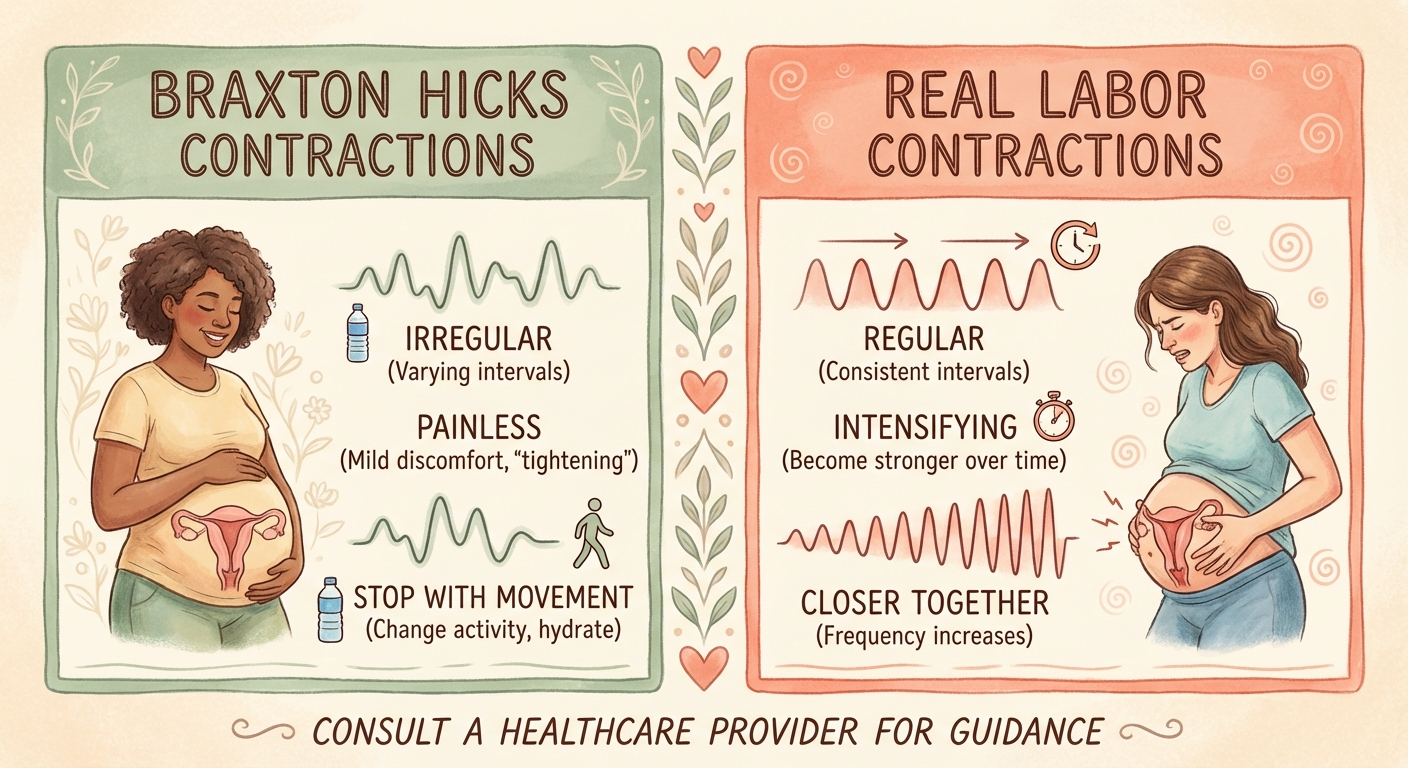
| Feature | Braxton Hicks | Real Labor |
|---|---|---|
| Timing | Irregular and unpredictable | Regular and progressive (5-10 min apart, getting closer) |
| Duration | Vary in length | Consistently 60 seconds or longer |
| Intensity | Stay the same or decrease | Progressively increase in intensity |
| Location | Usually felt in front of abdomen | Start in back, wrap around to front |
| Effect of movement | Often stop with position change or walking | Continue regardless of activity |
| Effect of hydration | Often subside with drinking water | Don’t stop with hydration |
| Cervical change | No cervical dilation | Cause progressive cervical dilation |
| Pain level | Uncomfortable but not usually painful | Progressively more painful |
What Triggers Braxton Hicks?
Dehydration: One of the most common triggers. Drink water and they often subside.3
Full bladder: Empty your bladder frequently.
Physical activity: Exercise, sex, or even just walking can trigger them.
Baby’s movement: Active baby can stimulate contractions.
Being touched: Someone touching your belly may trigger tightening.
Fatigue: Overexertion or exhaustion.
How to Ease Braxton Hicks
Hydrate: Drink 2-3 glasses of water. Dehydration is a major trigger.
Change positions: If lying down, stand up and walk. If active, sit or lie down.
Take a warm bath: Warmth can help relax your uterus (avoid very hot water).
Empty your bladder: A full bladder can trigger contractions.
Rest: Lie on your left side with pillows supporting your body.
Breathe deeply: Practice your labor breathing techniques.
Reduce activity: If overdoing it, slow down and rest.
When Braxton Hicks May Be Real Labor
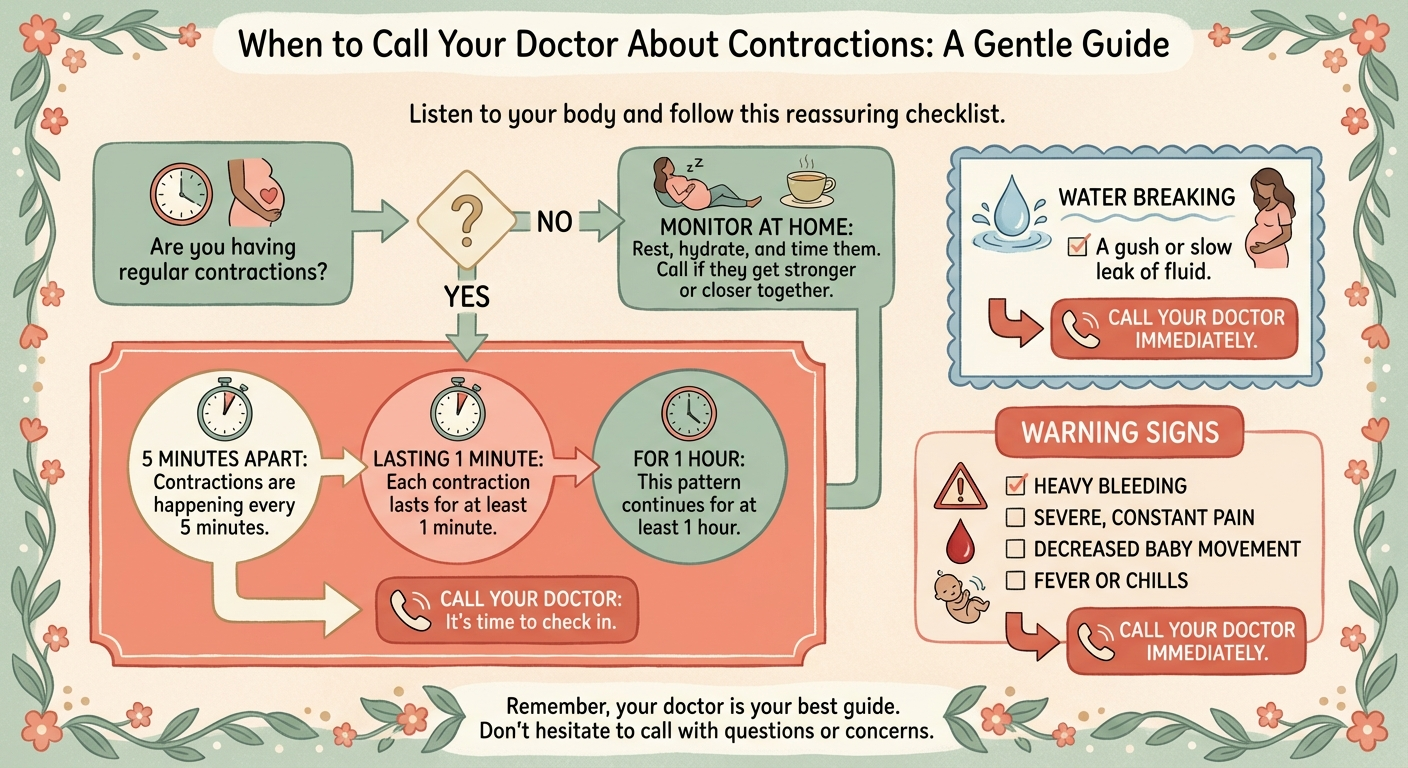
Use the 5-1-1 rule as a guideline to know when to call your provider or head to the hospital:4
5: Contractions are 5 minutes apart 1: Each contraction lasts at least 1 minute 1: This pattern continues for at least 1 hour
Additionally, contact your provider if:
Before 37 weeks: Regular contractions (4+ per hour) before full term could be preterm labor.5
Water breaks: If you feel a gush or steady leak of fluid, call immediately.
Severe pain: Pain that takes your breath away or prevents talking.
Vaginal bleeding: More than light spotting.
Decreased fetal movement: Noticeably less movement than usual.
Other symptoms: Severe headache, vision changes, severe swelling.
False Labor (Prodromal Labor)
Sometimes contractions become more regular and intense than typical Braxton Hicks but aren’t quite true labor yet. This is called false labor or prodromal labor.6
Characteristics:
- More intense than Braxton Hicks
- May have some regularity
- Can last for hours
- Eventually stop or become irregular again
- Don’t cause significant cervical change
What to do: Rest, hydrate, and monitor. If concerned, contact your provider. False labor often occurs in the days or weeks before true labor begins.
Third Trimester: When Braxton Hicks Intensify
Braxton Hicks typically become more frequent and noticeable in the third trimester, especially in the final weeks. This is normal and doesn’t necessarily mean labor is imminent.
Weeks 28-36: May feel Braxton Hicks daily, especially in evening.
Weeks 37-40: Can become quite intense and frequent. This is your body’s final preparation.
Differentiating from labor: Apply the 5-1-1 rule and other distinguishing factors.
Track Your Contractions with Nooko
When contractions start, it’s hard to remember timing in the moment. Nooko’s contraction timer lets you track timing, duration, and intensity with a single tap. The app automatically calculates patterns and lets you know when it’s time to contact your provider.
Share your contraction data with your healthcare team for accurate assessment of labor progress. Whether it’s Braxton Hicks or real labor, you’ll have the information you need.
Download Nooko on the App Store | Get Nooko on Google Play
References
Footnotes
-
American College of Obstetricians and Gynecologists. (2025). “How to Tell When Labor Begins.” https://www.acog.org/womens-health/faqs/how-to-tell-when-labor-begins ↩
-
Mayo Clinic. (2024). “Braxton Hicks contractions.” https://www.mayoclinic.org/healthy-lifestyle/pregnancy-week-by-week/expert-answers/braxton-hicks-contractions/faq-20057927 ↩
-
Cleveland Clinic. (2025). “Braxton Hicks Contractions.” https://my.clevelandclinic.org/health/symptoms/22965-braxton-hicks ↩
-
ACOG. (2025). “How to Tell When Labor Begins.” ↩
-
March of Dimes. (2024). “Preterm Labor and Premature Birth.” https://www.marchofdimes.org/find-support/topics/pregnancy/preterm-labor-and-premature-birth ↩
-
Mayo Clinic. (2024). “Braxton Hicks contractions.” ↩
Ready to track your pregnancy?
Join expecting parents using Nooko to track every milestone together.
Join the Nooko Beta →Get Weekly Pregnancy Tips
Expert advice for every stage of your journey
No spam. Privacy policy. Unsubscribe anytime.